title: How to convert a point cloud to Gaussian splats in Python (3DGS PLY) description: Initialise 3D Gaussians from a point cloud or mesh in Python and write a 3DGS-compatible PLY that opens in gsplat, Nerfstudio and the Hugging Face viewers: scale from k-nearest neighbours, identity rotation, SH degree-0 colour; load the bundled splat datasets.
How to convert a point cloud to Gaussian splats in Python
A Gaussian splat is a point with a covariance (three log-scales and a quaternion), an opacity and spherical-harmonics colour. The reference script initialises one Gaussian per point, which is the standard starting state of a 3DGS optimisation and already renders as a soft surface.
pip install "pardesline[local]"
python skills/gaussian-splatting/scripts/points_to_gaussians.py cloud.ply splat.ply --k 4
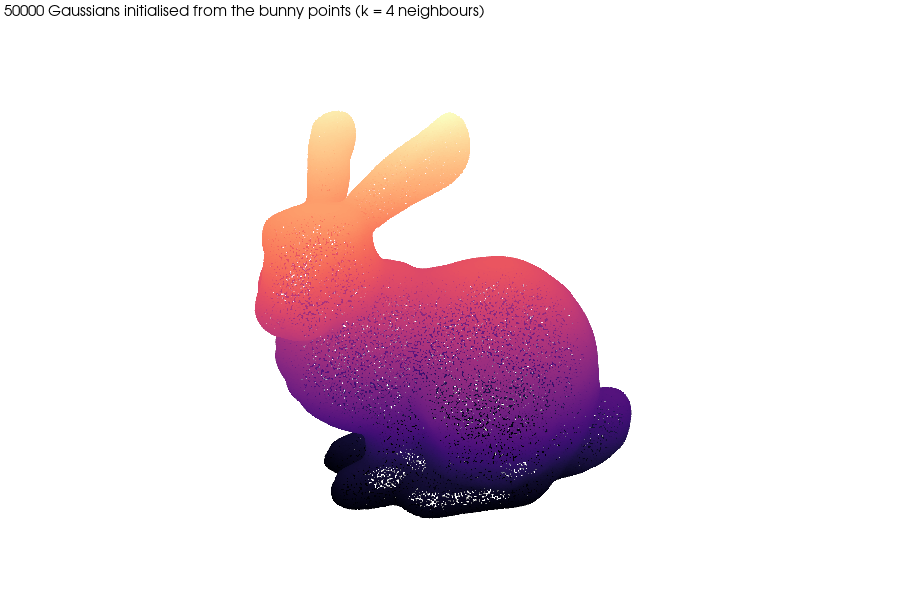
python examples/points_to_gaussians_bunny/run.py           # the bunny: 50 000 Gaussians, 12 MB
In Python, with the script's functions:
import pardesline as pl

points = pl.load("open3d_bunny")[0].mesh.to_points(num_points=50000, seed=1)
# the script reads any point cloud or mesh pardesline opens (raw arrays with --layout)
Per Gaussian: scale = log(mean distance to the k nearest neighbours) on the three axes, rotation = identity quaternion, opacity = logit(0.1), f_dc = (rgb - 0.5) / 0.2820948 with f_rest = 0. The PLY has the 62 floats per vertex the reference implementation expects; --sh-degree 3 adds the higher-order coefficients as zeros.
Reading splats back
splat = pl.load("splat.ply")  # a PointCloud: x, y, z are standard properties
centres = splat.to_numpy()
The extra properties (scale_0..2, rot_0..3, opacity, f_dc_*) stay in the file; a splat viewer renders them. Two bundled datasets ship fitted splats: c3vd_endoscopy_splats (colonoscopy scenes) and hf_kitti360_gs_subset (street chunks as .npy arrays with a layout).
From here
Optimising the Gaussians against images needs a renderer (gsplat, the reference CUDA code); the guide explains the parameters, the densification schedule and how medical volumes map onto the representation. A first-class Splat kind (render, convert to points, metrics) is on the roadmap.
Related: Guide: Gaussian splatting · 3D representations