title: How to reconstruct a surface from a point cloud in Python (Poisson, ball pivoting, alpha shapes) description: Point cloud to mesh in Python: clean the cloud, estimate oriented normals, Poisson reconstruction with density trimming so holes do not balloon, ball pivoting for thin structures, alpha shapes for convex-ish objects; what the defaults do and how to check the result.
How to reconstruct a surface from a point cloud in Python
import pardesline as pl

mesh = pl.load("open3d_bunny")[0].mesh
points = mesh.to_points(
    num_points=20000, seed=1
).clean()  # Poisson-disk sampling, statistical outlier removal
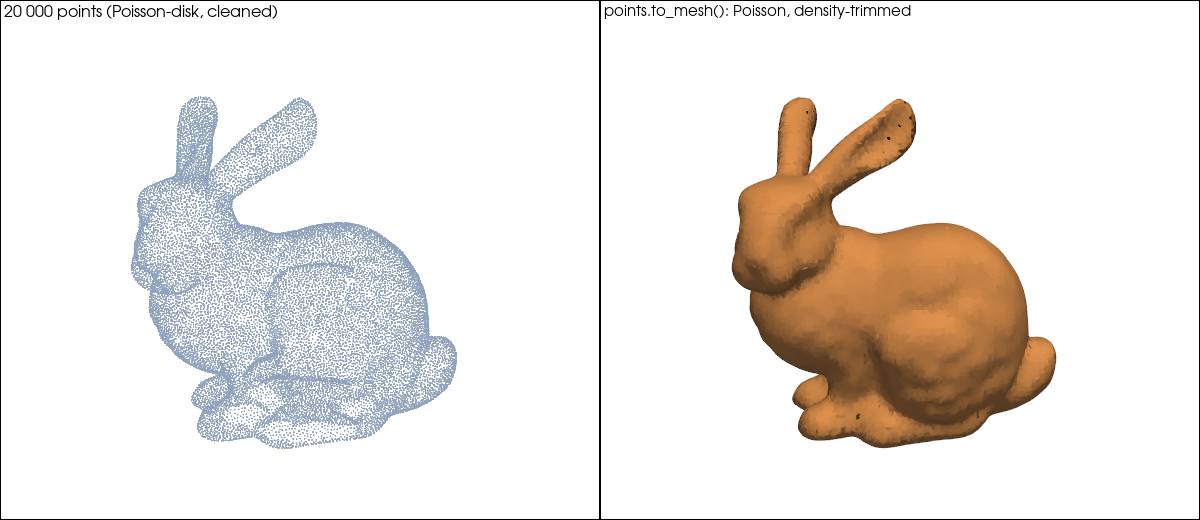
surface = points.to_mesh()  # Poisson, depth 9, density-trimmed at the 1 % quantile
surface.save("bunny_surface.ply")
print(surface.info(), surface.provenance[-1]["params"])
Your own scan: pl.load("scan.ply").clean().to_mesh(). The output is a clean, density-trimmed surface: Poisson closes the object, and the trimming removes the vertices with the least sample support, which is where it would balloon over holes and the unseen back side. It is lossy and parametric, and the sidecar records depth and density_quantile.
Choosing the method
| Method | Call | Good for | Watch out |
|---|---|---|---|
| Poisson | points.to_mesh() |
closed organic objects, scans with noise, 10k–1M points | balloons over holes without trimming; needs oriented normals (estimated if missing) |
| Ball pivoting | points.run("point_cloud_reconstruction.ball_pivoting") |
thin structures, uniform sampling, interpolating the points exactly | holes where the sampling is sparse; radius_factor relative to the point spacing |
| Alpha shape | points.run("point_cloud_reconstruction.alpha_shape", alpha=0.03) |
convex-ish objects, quick hulls with concavities | alpha in file units: larger than the gaps, smaller than the concavities |
| Convex hull | points.run("point_cloud_reconstruction.convex_hull") |
bounding geometry | no concavities |
Parameters that matter
depth(Poisson): 9 gives 512 cells across the bounding cube; 8 is Open3D's default and blurs small features; 10–11 need hundreds of thousands of points. Benchmark.density_quantile: 0.01 by default; 0.05–0.1 on very partial scans.- Normals: estimated at
normal_radius=0.1file units withnormal_orient_k=15when the cloud has none. Scans in millimetres neednormal_radiusscaled (about 5–10× the point spacing).
Check the result
import numpy as np
import open3d as o3d

tree = o3d.geometry.KDTreeFlann(points.to_open3d())
d = [np.sqrt(tree.search_knn_vector_3d(p, 1)[2][0]) for p in surface.to_numpy()[::50]]
print("median vertex-to-cloud distance", np.median(d))  # should be at the noise level
A vertex far from any input point is a balloon: raise density_quantile.
Related: point_cloud_reconstruction · Why our defaults work · Guide: 3D representations