How to extract DINOv3 features from medical images in Python
A frozen DINOv3 (or DINOv2) backbone turns an image into a grid of patch embeddings that already separate tissue, bone, instrument and background without any medical training. The reference script extracts them, colours them by PCA so you can see what the model sees, and saves them for a head.
pip install "pardesline[local]" torch transformers pillow
python skills/dinov3-dense-features/scripts/dinov3_features.py frame.png --out ./feats --model facebook/dinov2-small --size 448
python skills/dinov3-dense-features/scripts/dinov3_features.py ./echo_frames --out ./feats --model facebook/dinov3-vits16-pretrain-lvd1689m
Output per image: <name>.npz with patches (H/p, W/p, d) float16, cls (d,), the grid and the size, and <name>_pca.png. DINOv2 weights download without an agreement; DINOv3 weights are gated: accept the licence on the Hub, then huggingface-cli login. Grayscale images are replicated to three channels; --size is rounded to the patch size (14 for DINOv2, 16 for DINOv3).
The KITTI example runs it on a camera frame read out of the KITTI zip by HTTP Range:
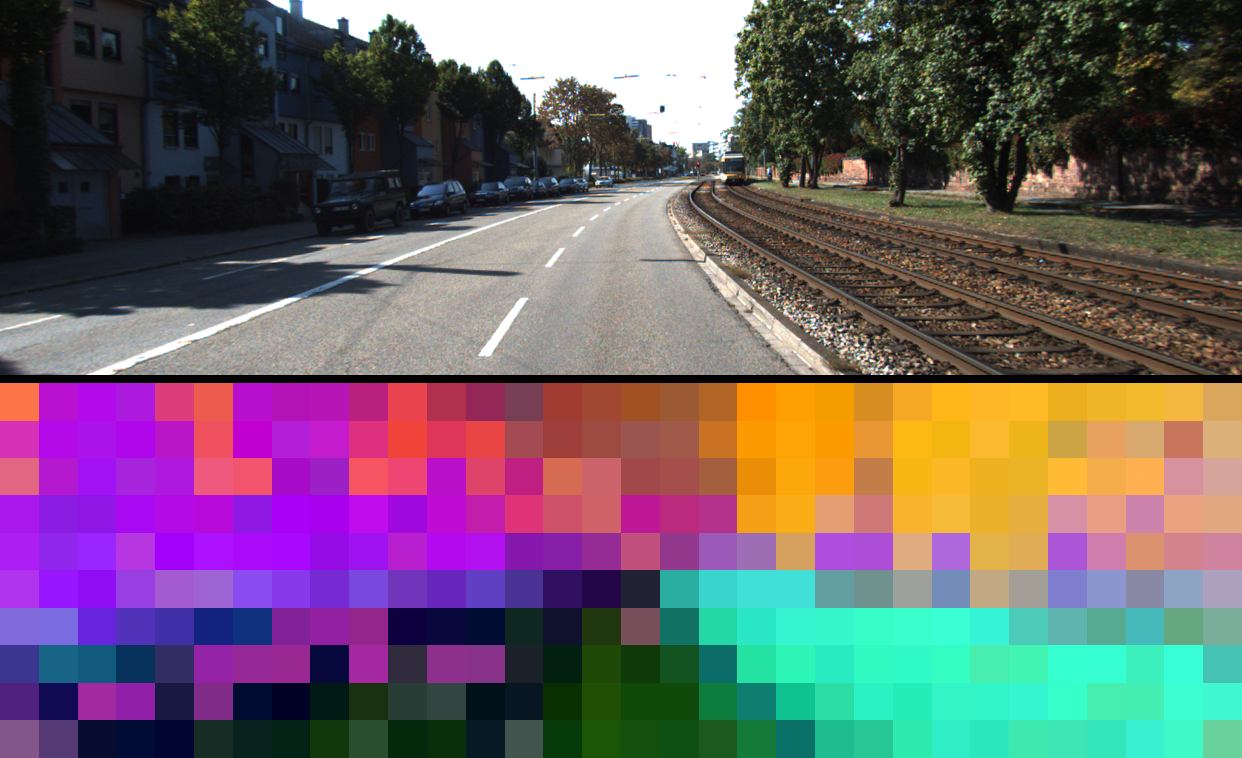
From a pardesline dataset
import pardesline as pl

frame = next(s for s in pl.load("kitti_raw_2011_09_26_drive_0001") if "image_left" in s.roles)
image = frame.image_left  # an Image object: image.path is the PNG
Volumes: extract per slice (vol.to_numpy()[z] to PNG) or use the 3D route (JEPA) when you need volumetric features.
A head on top
dinov3_faster_rcnn.py puts a Faster R-CNN detection head on the frozen backbone (the echocardiography use case of the DINOv3 guide); a linear or small convolutional head on the patch grid gives a segmentation. Keep the backbone frozen first: it is the point of the method, and it trains in minutes on CPU for small datasets.
Coming
One-line model access (pl.load_model("dinov3"), pl.run(model, dataset)) through the model registry; this page's commands keep working.
Related: DINOv3 model page · Models